
Regex – Regular Expression
A Regular Expression (or Regex) is a special sequence of characters used to search, match, and manipulate strings in text.
In programming, when we work with strings — searching, comparing, or replacing — regex gives us a flexible way to define patterns.
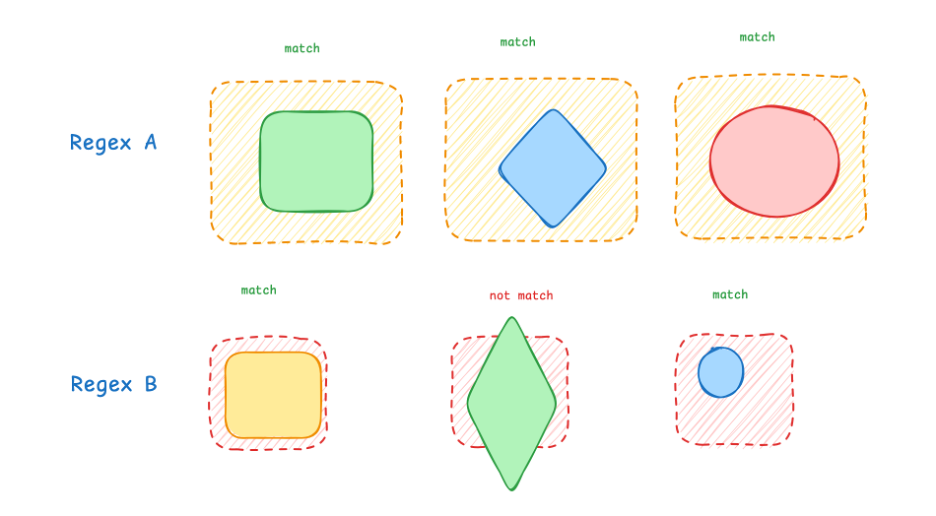
Think of regex as a template (mold): any string that fits the mold is considered a match.
Writing regex is like crafting a mold — everything that fits inside it will match.
I. Regex Components
Before writing complex patterns, let’s go through the most basic building blocks of regex.
Character Sets
| Pattern | Meaning |
|---|---|
[a-z] |
Lowercase letters a → z |
[A-Z] |
Uppercase letters A → Z |
[0-9] or \d |
Digits 0 → 9 |
\t, \n, \s |
Whitespace (tab, newline, space) |
. |
Any character except newline |
^ |
Start of a line |
$ |
End of a line |
A|B |
Match A or B |
Brackets & Quantifiers
| Symbol | Description (EN) | |
|---|---|---|
() |
Group – used for sub-patterns | |
[] |
Character class | |
{n} |
Exactly n times | |
{n,} |
At least n times | |
{m,n} |
Between m and n times |
Repetition Operators
| Symbol | Equivalent | Meaning (EN) | |
|---|---|---|---|
* |
{0,} |
Zero or more | |
+ |
{1,} |
One or more | |
? |
{0,1} |
Optional |
Example
ab? # matches "a" or "ab"
II. Advanced Patterns
Negative Lookahead (?!pattern)
Matches only if the pattern does not appear next.
import re

comp = re.compile(r'ab(?!cd)ef')

print(comp.match('abcdefgh'))  # None

print(comp.match('abefgh'))    # abef
Non-capturing Group (?:pattern)
Matches the pattern but doesn’t capture it.
import re

comp = re.compile(r'(\d{4})-(?:\d{2})-(\d{2})')

print(comp.findall('1999-06-07'))

# [('1999', '07')]
III. Example: Validate IPv4 Address
IPv4 has 4 octets separated by dots, each from 0–255.
Example: 192.168.1.1
Step 1: Define One Octet
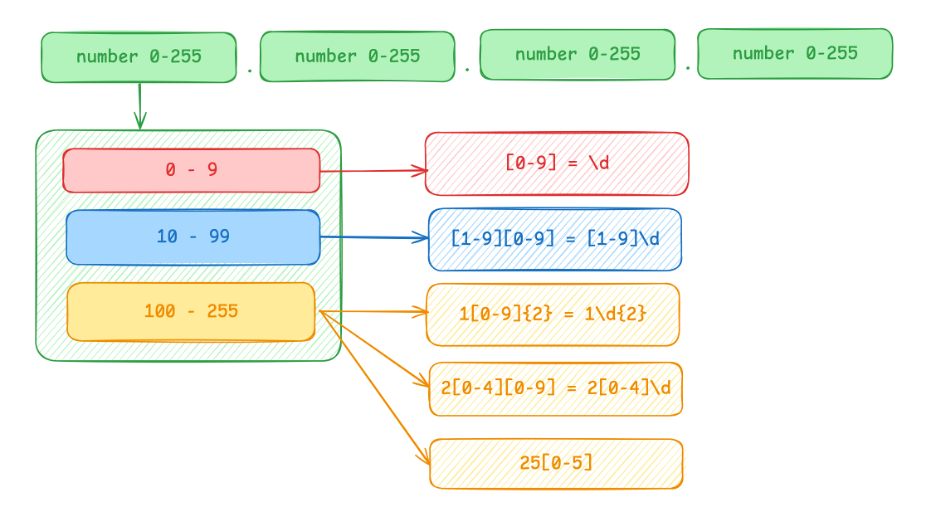
[0-9]|[1-9]\d|1\d{2}|2[0-4]\d|25[0-5]
Step 2: Combine Four Octets
Combine them with dots and use anchors ^ and $ to ensure full match
import re

regex = r'^(?:[0-9]|[1-9]\d|1\d{2}|2[0-4]\d|25[0-5])(?:\.(?:[0-9]|[1-9]\d|1\d{2}|2[0-4]\d|25[0-5])){3}$'

pattern = re.compile(regex, re.M)

content = """1.2.3.04

169.254.1.1

1.1.1.1

8.8.8.8

300.300.300.300

255.255.255.255

"""

print(pattern.findall(content))
Result
['169.254.1.1', '1.1.1.1';, '8.8.8.8', '255.255.255.255']
IV. Summary
Regex is a powerful pattern tool for developers — it helps validate inputs, extract data, and automate text handling.
Just remember: make it readable, or you’ll hate debugging your own regex later =)))